Category: Academic

  • Academic Misconduct

    Academic Misconduct

    At UC Berkeley, academic misconduct includes cheating, plagiarism (including self-plagiarism), facilitating academic dishonesty (allowing someone to cheat off of you or sharing answers), and fabrication/alteration of information. 

    Been accused of academic misconduct? Read our FAQ or open a case by emailing help@berkeleysao.org.

    Read below for more information about what happens when a professor/GSI suspect misconduct, informal meetings with the Center for Student Conduct, sanctions, and pathways forward.

    Quick Links: Faculty Disposition Form, Records Release Form

    If a professor or GSI suspects academic misconduct, they will report the incident to the Center for Student Conduct (CSC) and may reach out to you.

    Some best practices for communicating with faculty or responding to allegations:

    • Be open about your goals in the course.
    • Having a conversation or meeting is best, but if that isn’t possible, use clear and concise email language to explain your perspective.
    • Be patient and avoid spamming your professor, as they are often handling a large volume of emails.

    Your professor or GSI may ask you to sign a Faculty Disposition Form. Signing this form means that you accept responsibility and agree to any proposed conduct sanctions from the CSC as well as academic sanctions from the professor.

    If you would like to contest the alleged misconduct, you have the option to not sign the form and open an investigation with the Center for Student Conduct. Conduct sanctions will not be increased as a result of going to this process unless particularly compelling evidence of misconduct (beyond what was reported) is uncovered.

    Important things to note:

    • You may not drop the class if you have a case currently open with the CSC or if you accept responsibility for academic misconduct in the class. If you drop it, the course will be reinstated on your transcript by your college.
    • You may not change your grading option if you have a case open with the CSC or if you are found responsible for academic misconduct in the class. If you change your grading option to P/NP once academic misconduct has been alleged and you are found responsible, the graded option will be reinstated by your college.

    If the CSC determines that the incident reported may violate the Code of Conduct, they will open an investigation and send you an Alleged Violation Letter, which contains a brief description of the allegations, proposed sanctions, and options for resolution. It also includes a deadline by which you have to respond in order to meet with a CSC coordinator (note: you can request an extension if needed).

    One option for contesting the allegations on your AVL is an informal resolution meeting. This will give you an opportunity to share your side of the story and any evidence you have with a Conduct Coordinator. This meeting is also a place to have a conversation about the alleged misconduct, ways to learn and grow from this experience, and most appropriate sanctions. If you are found responsible after this meeting, you can contest the finding in a formal hearing.

    Preparing for informal resolution meetings:

    You may submit a Records Release form, which allows you to see any files the CSC has related to your case, including reports made by the instructor or evidence submitted. This can inform the points you make during the meeting.

    You may also compile your own evidence to be presented at the meeting. This can include:

    • Study materials, communication with classmates or course staff, browser history, documents and their revision history, course policies, etc.
    • It’s helpful to include materials with timestamps that can verify timelines.

    Other helpful tips:

    • Have a few main points ready to guide the conversation. You may want to use a powerpoint or compiled document to synthesize your evidence and general arguments, if you have evidence to present.
    • You may want to discuss contextual factors of an incident, your perspective of how it unfolded, and any individual circumstances you’d like your Conduct Coordinator to be aware of.
      It may be helpful to practice what you’d like to say with a close friend, family member, or SAO caseworker.

    The sanctions proposed on an AVL are the most severe sanctions you can receive for this incident. You can always contest your proposed sanction during informals or hearings.

    • For first-time academic misconduct or minor behavioral misconduct, the proposed sanction is typically a non-reportable warning. These are often proposed in conjunction with educational sanctions from the CSC, such as a written reflection or ethical decision making seminar. Non-reportable warnings are internal to the CSC and not visible on transcripts or to any outside body.
    • If there are previous instances of misconduct, the proposed sanction will likely be higher. Students facing suspension or dismissal from the University can open a case with SAO to receive additional support by emailing conduct@berkeleysao.org. The Center for Support & Intervention’s Respondent Services also provides assistance to students facing suspension or dismissal.
    • For academic misconduct cases, a professor may impose their own grade-based sanctions, which fall outside of the CSC’s control. Please refer to the section below for more information about these sanctions.

    Academic sanctions:

    • Your grade in a course is completely at the discretion of your professor, and the CSC does not make recommendations for grading consequences or impose any of these sanctions. However, professors typically apply sanctions based on the CSC’s outcome, so a finding of no responsibility would most likely lead a professor to restore your original grade.
    • Professors will apply whichever grade-based sanctions they deem appropriate if you are found responsible for academic misconduct by the CSC. Sometimes, this means a failing grade in the course or a 0 for an assignment, or in some cases, granting a NP. We find that it is best to talk through grade implications through an informal conversation with your professor. You may reach out to our office or the Ombuds Office to facilitate these conversations.
    • Professors may assign different sanctions to different students being accused of the same thing.
    • If you were found not responsible and encounter difficulty having a grade sanction lifted, you may reach out to our Academic Division at academic@berkeleysao.org, who can help facilitate conversations with your professor.

    You will receive an outcome from the CSC typically within 7 business days of your informal meeting, though this timeline can vary depending on the case.

    If you are found responsible and accept this outcome:

    • You may not drop the class after you were found responsible by the CSC. If you drop the course, it will be reinstated on your transcript by your college.
    • If you were taking the class for a letter grade, you may not change to P/NP after being found responsible. If you try to P/NP, your grading option will be reverted to graded.
    • If you were already taking the class P/NP, unfortunately, the policy is especially unclear and inconsistent. Our office has heard conflicting messages from different parties: one being that the original grading option should be honored, and the other being that it should be changed to a letter grade no matter what. If you would like to be assigned to an Academic caseworker who can look into your situation specifically with the Registrar, reach out to academic@berkeleysao.org.

    If you are found responsible and do not accept this outcome:

    You may contest the CSC’s outcome by requesting a formal hearing. If you would like a Conduct caseworker to help you prepare for your hearing and attend with you, please email conduct@berkeleysao.org.

    If you are found not responsible:

    • The CSC will notify your professor about the outcome of your case. However, you may reach out to your professor a few days after the decision, or more immediately if your situation is urgent, to follow up and confirm that your grade will be appropriately calculated. If you’d like assistance in navigating this, our Academic caseworkers can reach out and communicate on your behalf.
    • If you were found non-responsible and encounter difficulty having a grade sanction lifted, reach out to our Academic division at academic@berkeleysao.org, who can help facilitate conversations with your professor.
    • You may only formally appeal your grade on three grounds specified by the Academic Senate Regulation A.207.A. If your case does not fall under these three grounds, you may not submit a formal grade appeal. If it does, our office can assist with drafting the grade appeal petition, compiling evidence, and submitting it for review by the Academic Senate.

    Retaking the class:

    • You may retake the class if you have received a grade below a C- (D+, D, D-, F, or NP).
    • Courses previously taken for a letter grade may only be repeated for a letter grade. After repeating a course, both grades will show on the transcript, but only the most recent grade will be calculated into your GPA. As a general rule, when repeating a course for the first time, it is the 2nd attempt that counts.
    • If you received an NP and have taken the course only once before, you may repeat the course for either a letter grade, if allowed in the course, or take the course on a pass/no pass basis.

    Needing the class to graduate/as a prerequisite:

    • If you need the class to graduate: it is best to schedule a meeting with your college and/or major advisor to figure out a course of action as soon as possible. Sometimes major departments will accept P/NP grading or make exceptions for requirements.
    • If you need the class as a prerequisite for a course you’re taking next semester/right now: schedule a meeting with your college advisor or current Professor/GSI to see what protocol to follow. This varies on a case by case basis. Sometimes you might have to drop the course and will need to retake the prerequisite or the department will make an exception.

    Professors can submit the incident report at any point until 60 business days since they reasonably could have been aware of the misconduct. The CSC sends students an AVL about a week after receiving an incident report from a professor.

    The CSC process timeline depends on the CSC’s case volume and how much investigation your case requires. Typically, you can expect to schedule an informal resolution meeting within a couple weeks of receiving your AVL, then expect an outcome around 7 business days after that meeting. It’s always best to check with your Conduct Coordinator specifically about what their estimated timelines are for your case.

    Please visit our Resources page for a list of mental wellness resources.

    If you have questions related to DSP accommodations, or believe you were unfairly targeted because of your identity or DSP accommodations, please reach out to grievance@berkeleysao.org.

    If you have concerns about your financial aid package and would like support from our office, please reach out to finaid@berkeleysao.org.
  • Enrollment and Dismissal Cases

    Dismissal and Academic Probation 
    If a student earns less than a 2.0 grade point average in any one semester, the University will notify the student of their changed status from Good Standing to Academic Probation. Terms of Academic Probation vary slightly between the Colleges. However, most commonly a student must earn higher than a 2.0 and earn zero F grades in the following semester to be removed from Academic Probation. If these terms are not met and the student earns less than a 2.0 and/or any F grades in the next semester, it is likely that they will be dismissed from the University.

    In order to appeal the dismissal, students must either successfully appeal individual grades that significantly affect their final standing, or negotiate their standing with the Academic Advisor or Student Affairs Officer.

    Dropping a class/changing a grading option after the Deadline 
    The drop deadline for most colleges is the Friday of the second week of the semester for impacted courses, and the Friday of the fifth week for all other courses. After this deadline you can no longer add or drop classes, nor change variable units in a class. The deadline to change your grading option is the Friday of the tenth week.

    It is possible to petition the University to retroactively change your status in a class after either deadline. However, these petitions are usually unsuccessful in cases that do not involve serious unexpected circumstances – such as a significant health problem. In addition, the petition process varies between the Colleges. If you would like to petition the University for a retroactive drop or change to your grading option, please stop by 204 Eshleman for further assistance.

    Tele-Bears
    Though Telebears may be considered a foolproof system to manage your class schedule, every so often a systemic glitch will lead to changes that you may not be aware of until it is too late.

    Check Telebears often and print a hard copy of your final schedule to prevent later problems. If you find that your schedule has been changed without your knowledge or approval, visit the Registrar’s office immediately.

  • Withdrawing from the University: A Friendly Guide

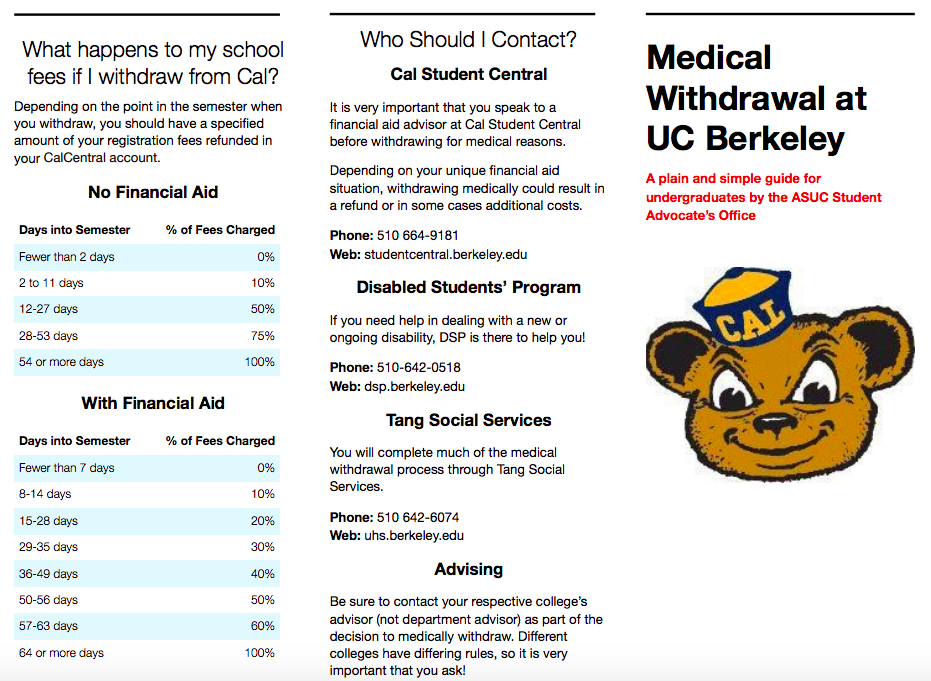
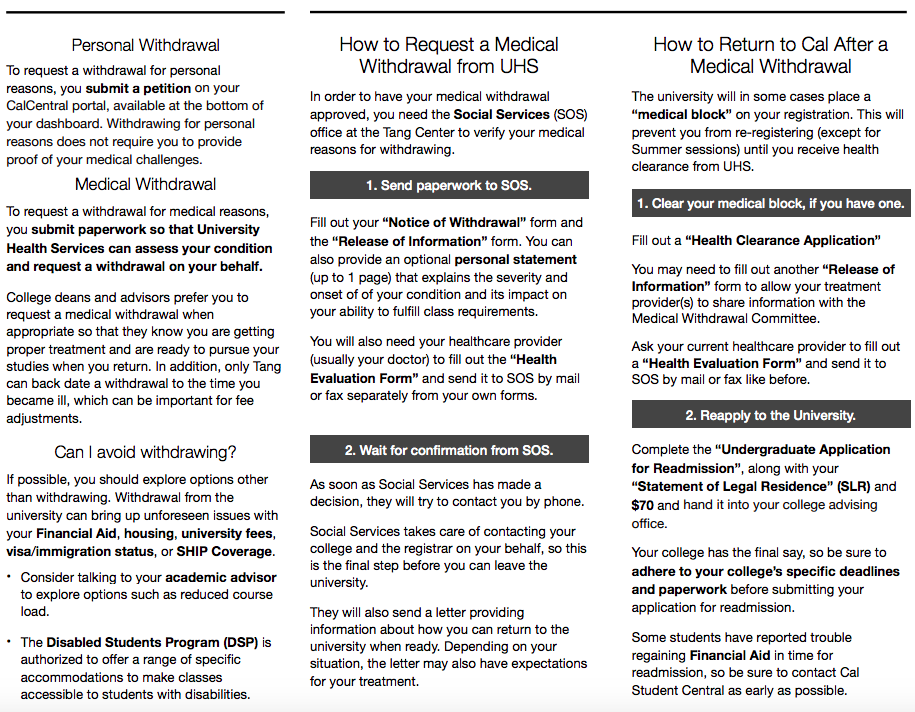
    Click the images below to see our printable pamphlet, or read on to see the text on this site.


    What are my options?

    Personal Withdrawal

    To request a withdrawal for personal reasons, you submit a petition to your specific college. Withdrawing for personal reasons does not require you to provide proof of your medical challenges.

    Medical Withdrawal

    To request a withdrawal for medical reasons, you submit paperwork so that University Health Services can assess your condition and request a withdrawal on your behalf. College deans and advisors prefer you to request a medical withdrawal when appropriate so that they know you are getting proper treatment and are ready to pursue your studies when you return. In addition, only Tang can back date a withdrawal to the time you became ill, which can be important for fee adjustments.

    See the bottom of this page at “HOW TO REQUEST A MEDICAL WITHDRAWAL FROM UHS” for a step-by-step process.


    Can I avoid withdrawing?

    If possible, you should explore options other than withdrawing. Withdrawal from the university can bring up unforeseen issues with your Financial Aid, housing, university fees, visa/immigration status, or SHIP Coverage.

    Consider talking to your academic advisor to explore options such as reduced course load. The Disabled Students Program (DSP) is authorized to offer a range of specific accommodations to make classes accessible to students with disabilities.


    Important Contacts

    Cal Student Central

    It is important to speak with a financial aid advisor at Cal Student Central before withdrawing from the university for medical reasons. Depending on your financial aid situation, medical withdrawal could result in a refund or in some cases additional costs.


    Disabled Students’ Program

    If you need help dealing with a new or ongoing disability, the Disabled Students’ Program (DSP) is there to help you!


    Tang Social Services

    You will complete much of the medical withdrawal process through Tang Social Services.


    Advising

    Be sure to contact your respective college’s advisor (not department advisor) as part of the decision to medically withdraw. Different colleges have different rules, so it is very important that you ask!


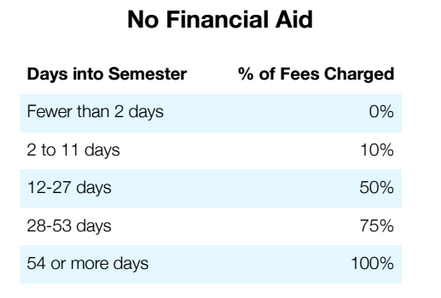
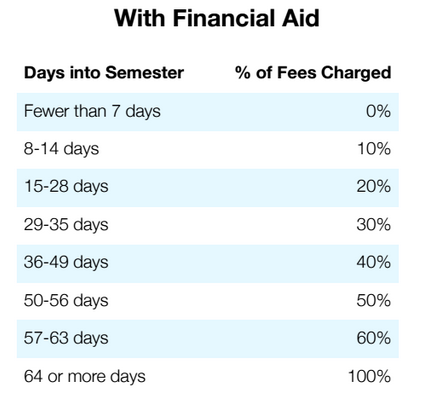
    What happens to my school fees if I withdraw from Cal?

    Depending on the point in the semester when you withdraw, you may have a specified amount of your registration fees refunded in your CARS account.

    Screen Shot 2015-04-20 at 8.47.20 PM

    Screen Shot 2015-04-20 at 8.49.35 PM


    Tables from: registrar.berkeley.edu/canwd.html

    If you are a financial aid recipient and withdraw, you may have to pay back all or part of your financial aid as you may no longer be eligible for the full amount of aid. You will be held responsible for all Housing and Dining charges prior to the first day of courses and after your effective date of withdrawal, if you are still in student housing.

    Fee adjustments, if any, are based on your withdrawal date. All fee adjustments for withdrawals are applied to your student account and may be applied to any outstanding debts. If you are participating in the Deferred Payment Plan and have not paid all your fees, you may still owe fees to the University. Please see tables below for prorated amounts.

    These fees are nonrefundable:

    • late fees
    • health insurance
    • class pass
    • document management

    How to Request a Medical Withdrawal from UHS

    In order to have your medical withdrawal approved, you need the Social Services (SOS) office at the Tang Center to verify your medical reasons for withdrawing.

    Medical withdrawals are considered for the current or previous semester. To be eligible for a medical withdrawal you must have registered and paid a percentage of your fees for the semester.

    1. Send paperwork to SOS.

    Information Required (See the Checklist for Medical Withdrawals)

    • Submit a Notice of Withdrawal form
    • Detailed medical record information (including diagnosis and treatment)
    • Your UHS medical record may be reviewed with a Release of Information Form
    • If you were treated in the community or at the UHS Counseling & Psychological Services, request that a Health Evaluation Form be completed by your provider. Your outside medical records can be reviewed with this Release of Information form.
    • You may also submit a brief explanation (up to one page) of the reasons you are requesting a medical withdrawal.

    Medical Withdrawal and Readmission Forms are also available in-person at the Social Services office.

    All information should be sent to Social Services, along with a copy of the Release of Information form you sign, so your provider can communicate with us.

    The above information is reviewed to determine if the medical condition warrants a medical withdrawal. The withdrawal determination is based on the severity and onset of your condition and its impact on your ability to attend classes over a period of time. The medical withdrawal documentation is also reviewed to determine what, if any, medical documentation will be necessary for health clearance when you seek to return to school. It is common for continued treatment over a period of time to be required as a condition of clearance.

    2. Wait for confirmation from SOS.

    As soon as Social Services has made a decision, they will try to contact you by phone. Social Services takes care of contacting your college and the registrar on your behalf, so this is the final step before you can leave the university.

    They will also send a letter providing information about how you can return to the university when ready. Depending on your situation, the letter may also have expectations for your treatment.


    How to Return to Cal After a Medical Withdrawal

    The university will in some cases place a “medical block” on your registration. This will prevent you from re-registering (except for Summer sessions) until you receive health clearance from UHS.

    1. Clear your medical block, if you have one.

    Fill out a “Health Clearance Application”. You may need to fill out another “Release of Information” form to allow your treatment provider(s) to share information with the Medical Withdrawal Committee. Ask your current healthcare provider to fill out a “Health Evaluation Form” and send it to SOS by mail or fax like before.

    2. Reapply to the University.

    Complete the “Undergraduate Application for Readmission”, along with your “Statement of Legal Residence” (SLR) and $70 and hand it into Cal Student Central in Sproul Hall.

    Your college has the final say, so be sure to adhere to your college’s specific deadlines and paperwork before submitting your application for readmission.

    In order to make sure you have timely Financial Aid support for your return semester,  be sure to contact Cal Student Central as early as possible in your readmission process.


    Helpful Links:

  • How To: Complete a Grade Appeal

    Formal Grade Appeal Process

    We are here to help! Contact us at academic@berkeleysao.org and we’ll assign you a caseworker who will guide you through the process, start to finish!

    How it Works

    The full process (on which this section is based) is listed here: http://guide.berkeley.edu/academic-policies/

    Part 1: Unit (Department) Level

    1. Each department or other instructional unit shall establish a standing grievance committee chair who is not the chair of the department.
    2. For each case, this chair will appoint an ad hoc grievance committee, consisting of:
      1. Three faculty members
      2. One faculty member from the same department/unit
      3. One faculty member from a different department/unit
      4. Two students in good standing appointed by the student association of the department.
    3. The ad hoc grievance committee will review all the required materials (from the student and instructor) and make a recommendation regarding a resolution.

    Part 2: COCI

    1. This recommendation is then sent to COCI (Committee on Course Instruction), including minority views, in writing.
    2. COCI has the power to change the grade, drop a course retroactively, or retain the course but eliminate the grade from the GPA.
      1. Note that changing the grade to a letter grade and not just a P requires that four out of the five ad hoc committee members need to recommend it.

    Timing

    1. The process must be started one calendar year from the last day of the semester in which the final grade for the course was posted.
    2. The formal procedure, once initiated, is to be completed at the unit level within 20-working days and at the Senate level within 40-working days if both parties are in residence and the University is in regular session.

    Student Instructions

    The full process (on which this section is based) is listed here: http://academic-senate.berkeley.edu/committees/coci/procedures-grade-appeals-based-alleged-use-non-academic-criteria

    (look especially at III.B for student instructions)

    Step 0: Informal Attempts

    If you have a grievance about a grade, you should first try to speak with your instructor and/or the student ombuds.

    Step 1: Assess the Strength of Your Case

    The following are grounds for appeal:

    1. the application of non-academic criteria, such as:
      1. the consideration of race, politics, religion, sex, or other criteria not directly reflective of performance related to course requirements;
    2. sexual harassment;
    3. or improper academic procedures that unfairly affect your grade.

    Step 2: Initiate the Formal Process

    Requirements are listed here: http://academic-senate.berkeley.edu/sites/default/files/committees/coci/gradegrievancechecklist_2011_v2.pdf

    Submit the case in writing to the department chair. Emailing is perfectly fine. This email should include your entire case:

    1. Specify clearly the grounds on which you are disputing the case, as listed here:
      1. Discrimination
      2. Sexual harassment
      3. Improper academic procedures that unfairly affect your grade
    2. There should be a “description of the basis for grievance”, and, if it exists, the original work in question.

    From here, the entire departmental process, including the ad hoc committee, must be completed within 20 days of the date of the email and sent to COCI.

    Step 3: Wait for, then respond to, the instructor’s rebuttal.

    1. The instructor will write and send a rebuttal through the ad hoc committee.
    2. Write a rebuttal to that rebuttal.
    3. The instructor will have one last chance to write another rebuttal before the case is judged and sent to COCI.

    Step 4: Option to submit additional written materials to the ad hoc committee

    1. The ad hoc grievance committee will meet to discuss all these materials. The student and instructor may present additional information in writing to the ad hoc grievance committee:
      1. prior to the meeting or,
      2. At the option of the ad hoc grievance committee chair, in person to the ad hoc grievance committee.
    2. Neither party may be present while the other is appearing before the committee or while the committee is deliberating.

    Step 5: Wait

    1. The department chair will forward all relevant documents and notify COCI in writing of the recommendation within two weeks of receiving the report from the ad hoc grievance committee.
    2. From here, all you can do is wait for the COCI judgement. This is required to take a maximum of 40 working days.