Category: Grievance

  • Grievance Resources

    UCPD

    This police department is located on campus and available 24/7. Tasked with the particular duties of keeping the U.C. Berkeley campus area safe, you can report a non-emergency at any time to (510) 642-6760 or call 9-1-1 for emergency assistance.

    To find the police department, head into:

    1 Sproul Hall
    Berkeley, CA 94720

    http://police.berkeley.edu

    Office for the Prevention of Harassment and Discrimination (OPHD)

    This office will handle any formal grievance procedure regarding harassment or discrimination of any kind you bring forward. The staff is your liaison between your desired outcome and the university. Typically OPHD launches investigations that conclude with resolutions to your case.

    Please direct inquiries to:

    Denise W. Oldham

    Director and Title IX Officer and Officer for OPHD

    dwoldham@berkeley.edu

    685 University Hall, #1120
    Berkeley, CA 94720

    (510) 643-7985

    http://ophd.berkeley.edu


    Tang Center (University Health Services)

    Visit Tang for medical services, counseling, and other related health and wellness issues. Tang is the campus’ most available medical resource and accommodates the university’s students, faculty, and staff.

    Please visit Tang at:

    2222 Bancroft Way
    Berkeley, CA 94720

    Monday-Friday: 8am-5pm

    Saturday: 9am-5pm

    To make an appointment: https://uhs.berkeley.edu

    For After Hours Assistance call (510) 643-7197

    For an Advice Nurse call (510) 6437197

    Other useful resources in Tang:

    • Counseling and Psychological Services (CPS), 3rd floor (510) 642-9494
    • Social Services, 2nd floor (510) 642-6074
    • Sexual Assault Education and Response, 2nd floor (510) 642-6074


    Gender Equity Resource Center

    This campus resource is incredibly useful as a community center for students in any issue regarding gender and sexuality. You will find both support and avenues for advocacy. Overflowing with brochures of community centers on and off campus  related to issues of women’s and lesbian, gay, bisexual, transgender communities and knowledgeable staff willing to help you find adequate resources, the GenEq Center is invaluable.

    202 Cesar Chavez
    Berkeley, CA 94720

    (510) 642-4786

    http://geneq.berkeley.edu


  • How To: File a UCPD Complaint

    Filing a complaint with UCPD initiates an internal investigation process and guarantees that your complaint will be responded to. A complaint may be made at any time in the day or night to any police department employee and will be referred to the Duty Supervisor. The procedure for filing a complaint and the complaint form can be found on the UCPD’s website at: http:// police.berkeley.edu/about_UCPD/complaint.html

    Keep in mind that complaints must be made within 30 calendar days from the date of the alleged incident or 90 calendar days after the alleged incident for sexual harassment allegations.

    To effectively submit a UCPD complaint, follow these steps:
    1. Go to the UCPD Records Unit at #1 Sproul Hall (Phone 510-642-6760) and get a copy of the incident report. This is a report made by the responding officer/s with details regarding the incident. Knowing what the official record shows will help you in disputing details or highlighting inappropriate action by the officer/s. NOTE: UCPD does not allow SAO caseworkers to retrieve this report on your behalf.

    2. Get the name of the officer/s who responded to the incident. This is normally on the violation you received or incident report. If you do not have either of these papers, go to the UCPD office at #1 Sproul Hall to find out which officer/s responded.

    3. Get the names and contact information of anyone who witnessed the incident.

    4. Write a statement describing your complaint. You can access the complaint form here: http://police.berkeley.edu/forms/CitizenComplaint.pdf or obtain the form at any of the following locations:

    • The Police Review Board in care of Kathleen Moore, Office of the Vice Chancellor-Administration, 200 California Hall, 642-3100
    • UCPD, #1 Sproul Hall, 642-6760 or police@berkeley.edu
    • ASUC Student Advocate, 204 Eshleman Hall, 642-6912
    • LEAD, 102 Hearst Gym | Hours M-F: 9am-5pm | Phone: 510-642-5171 | Email: lead@berkeley.edu l, 642-5171
    • Office for the Prevention of Harassment and Discrimination, 2111 Bancroft Way, Suite 300
    • Office of Community Relations, 2130 Center Street, 643-5299

    Tips for writing your statement:

    Type your response.  Although space is provided on the complaint form, typing your statement will make it easier to read and allow you to expand your response.
    Provide background for the incident. Officers don’t know what happened before they arrived on scene, so explaining the events leading up to the reported incident will help give context.
    Give details. The officer/s incident reports may leave out important details that support your version of the incident. Make sure to provide these in your statement.
    Explain how you were harmed. Be concise about the specific harm that was done to you by the UCPD officer/s. Using bullet points or bolding the separate harms caused will make them easier to catalog.
    Avoid using inflammatory or angry language. This may take a lot of willpower to do, but it will help highlight that you were treated unfairly and have a legitimate complaint to make.

    5. File the complaint at any of the locations listed above.

    Additional Assistance:

    1. Feel free to contact the Student Advocate’s Office if you would like guidance or assistance on submitting a UCPD complaint. You will be assigned a caseworker from the Grievance Division who will help you.
    2. You may also contact the OMBUDS Office for informal resolutions (appointments must be made by calling 510-642-5754, no drop-ins).

    3. You may also contact Student Legal Services, by appointment or drop in at #102 Sproul Hall (510-642-5171). The Attorney for Students advises currently registered students regarding their legal questions, rights, and obligations. http://sa.berkeley.edu/legal

  • How To: Report Sexual Harassment / Sexual Assault

    We understand that the decision to report is difficult. However, if you wish to report an incident of sexual harassment or sexual assault, this post will explain how to report, the steps that may follow, and give some general tips. It will describe the different ways of reporting, including Anonymous, Third-Party, and Self Reporting. It will outline the processes of both Informal and Formal Investigations conducted by the Office for the Prevention of Harassment and Discrimination (OPHD).  Finally, at the bottom, you will find some Tips from SAO and Resources.

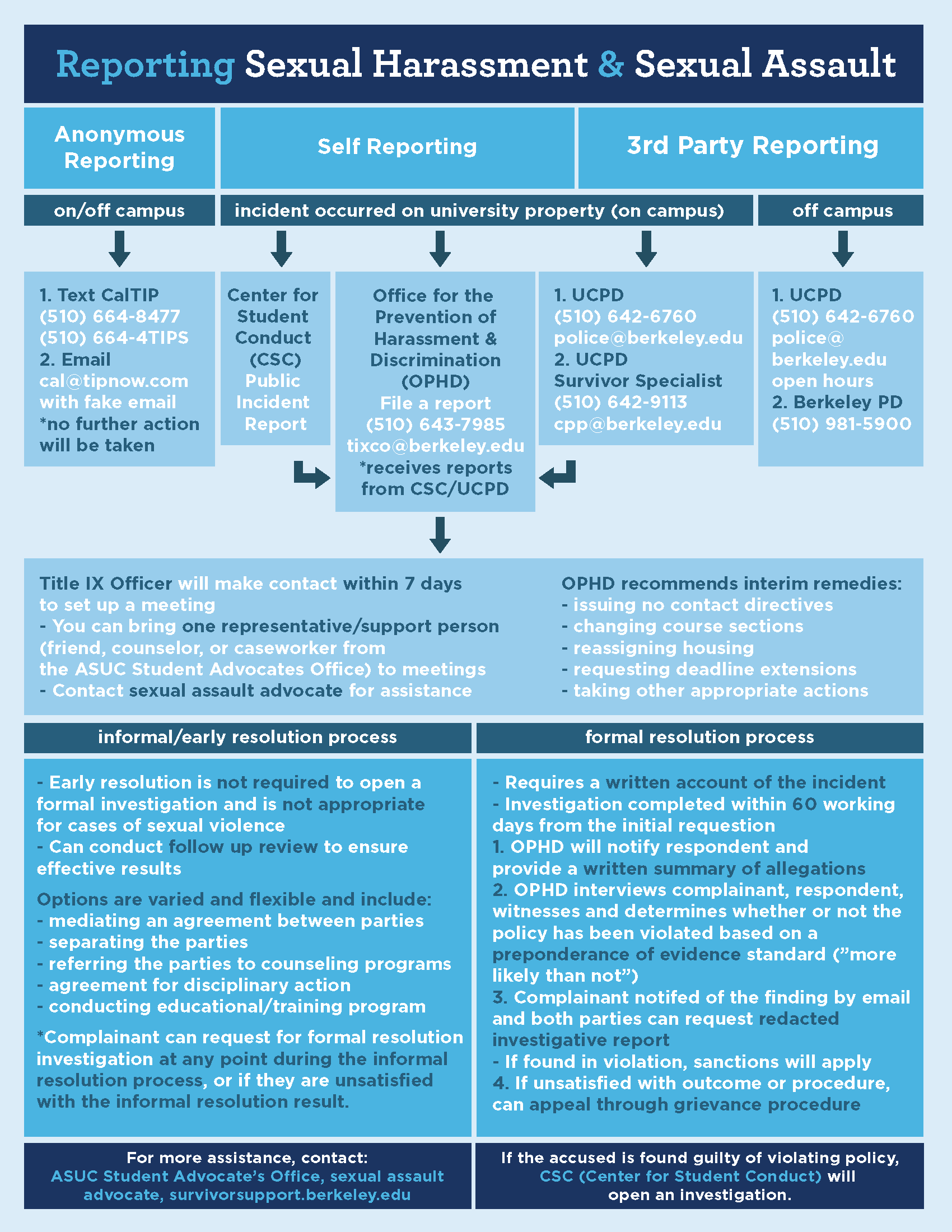
    Below is a caseworker-created infographic from the Grievance division. To see in detail, click the infographic and zoom in using your computer’s web browser.

    reportingsexualharassment

    Report Anonymously:

    • Understand that anonymous reporting means that you do not wish to disclose your name or any of the identities of the parties involved, and you do not want any action to be taken.
    • You can report anonymously using CalTIP (Berkeley’s text-based anonymous reporting tool to report non-emergency criminal activity) by texting (510) 664-8477 (4-TIPS), or by emailing cal@tipnow.com using a made up account.

    Report as a Third-Party/Self-Report:

    • Understand that once the University is aware of something threatening to the safety of the campus (such as a severe act of sexual harassment or sexual assault), the University has an obligation to investigate the incident whether you or the survivor is compliant or not.
    • There is no stated timeframe for reporting, but prompt reporting will better enable the University to provide an appropriate response. We encourage that all incidents be reported, even if a significant amount of time has passed.
    • You may report through the Center for Student Conduct by filing a Public Incident Report. Since the nature of the report concerns sexual harassment or sexual assault, this report will be forwarded to OPHD. The process for OPHD’s investigation will be outlined further below. This may be the best option if you want to initiate a Formal Investigation, which requires a written report.
    • You may also report through UCPD by calling their 24-hour non-emergency line at (510) 642-6760 (or 2-6760 from a campus landline), emailing police@berkeley.edu, or visiting the police department during open hours. Reporting to the police does not mean you are committed to filing charges.
    • If the incident occurred on University property, then UCPD will either conduct their own investigation, forward the case to OPHD, or do both, depending on the situation.
    • If the incident occurred locally, but off campus, UCPD will forward the case to Berkeley Police who will conduct the investigation. Alternatively, you can contact the Berkeley Police directly at (510) 981-5900police@cityofberkeley.info, or http://www.ci.berkeley.ca.us/police/.

    OPHD Investigation:

    • If you have chosen to report and OPHD has received your incident report, the Title IX Officer (Sexual Harassment Officer) will contact you, usually within 7 business days, to set up a meeting.
    • You should also receive a written explanation of your rights and options including: to whom to report, options for reporting to law enforcement, complainant rights such as no contact orders or restraining orders, importance of preserving evidence, existing campus services available, applicable procedures for disciplinary action, and options to change academic, living, transportation, and working situations.
    • Going into the meeting, be aware of your right to have one representative or designated support person accompany you. This may be a personal friend, a counselor, or a caseworker from our office who will advocate for you. You will have this right for all subsequent proceedings or meetings.
    • During the meeting you will have the option to pursue Early Resolution, Formal Investigation, or file a Formal Grievance. Details on filing a Formal Grievance can be found here. Information about the range of possible outcomes, including interim protections, remedies for the person harmed by the incident, and potential disciplinary actions will be provided for each option.

    Early Resolution (Informal Investigation):

    • Early Resolution is NOT required to open a Formal Investigation, and in some cases of sexual harassment or sexual violence, is not appropriate, and will be directly forwarded to a Formal Investigation.
    • The options for this have a wide range and are very flexible.
    • Results may include mediating an agreement between the parties, separating the parties, referring the parties to counseling programs, negotiating an agreement for disciplinary action, conducting targeted preventive educational and training programs, or providing remedies for the individual harmed by the offense.
    • It can also include options such as discussions with the parties, making recommendations for resolution, and conducting a follow-up review after a period of time to assure that the resolution has been implemented effectively.
    • This is recommended for anonymous reporting or third-party reporting.
    • The University cannot compel you to be involved in mediation. Mediation, even if voluntary, may not be used in cases involving sexual violence.
    • If Early Resolution is not appropriate, or is not successful, a Formal Investigation will be opened.

    Formal Investigation:

    •  Formal Investigation requires a written account of the incident. 
    • If the alleged conduct also contains criminal acts, both this Formal Investigation and a criminal investigation will run concurrently.
    • The investigation should be completed within 60 working days from the request of a formal investigation. The deadline may be extended on approval by the designated University official, but in such case, you will be notified of this extension.
    • The investigation will generally include interviews with the people involved. You may request to be notified of the date when interviews have begun. The people interviewed are told only what is necessary for a fair and thorough investigation, and that maintaining confidentiality is essential to the integrity of the investigation. As a witness, discussion of the investigation to the complainant or the accused is heavily discouraged.
    • At any time during the investigation, the investigator may recommend interim protections or remedies which must be abided, otherwise you will be in violation of the Policy.
    • You will be notified by the investigator when the fact-finding portion of the investigation is finished.
    • After evidence is collected, determination of violating Policy is based on a preponderance of evidence, meaning a more likely than not standard. Essentially, if the investigator feels like there is a 50% chance that the incident violating Policy had occurred, then the investigator will find the alleged in violation.
    • You will be notified of the final finding as to whether or not the Policy was violated. This will not include the written investigative report. However, you may request the redacted version of the report, which will at a minimum include a statement of the allegations and issues, the positions of the parties, a summary of the evidence, findings of fact, and a determination by the investigator whether this Policy has been violated.
    • If you are unsatisfied with the outcome or believe that the actions following the report of sexual harassment/sexual violence did not follow Policy, then you can file a Formal Grievance. For the former situation, the Early Resolution or Formal Investigation will act as the first step(s) of the Grievance procedure.

    Disciplinary Action:

    • If the alleged is found in violation of the Policy, then OPHD’s finding will be forwarded to the Center for Student Conduct (CSC). The finding may or may not include recommended disciplinary action; however, CSC will use the finding as evidence for their process.
    • Next, CSC will notify both you and the respondent when they start pursuing the case. This officially begins the conduct process.
    • An informal process will be pursued first. Someone from CSC will meet with the respondent to discuss possible sanctions, then you will be contacted for an informal meeting to discuss what you would like, and your preferences in regards to sanctions.
    • After these conversations, an Alleged Violation Letter (AVL) is sent to the respondent. The AVL contains the charge, a brief explanation of the facts that support the charge, and a recommended sanction.
    • Usually, for cases of sexual harassment, a sanction will be no less than  disciplinary probation for the remainder of the alleged’s time at the university. Other educational programs and/or reflection exercises might be additionally sanctioned.
    • The alleged will either accept the proposed sanctions, request a formal hearing, or not reply (in which case, sanctions outlined in the AVL are imposed). You will be contacted with either the result of the case or a notice that a formal hearing will be conducted.
    • If the alleged has accepted the proposed sanctions, but you are unsatisfied with the result, then you are allowed 10 days to submit a written appeal to the Deal. This is the last line of appeal. Understand that if you accept an informal resolution, you are waiving your rights to an administrative hearing and further appeal.
    • If the alleged opts for a formal hearing, then a Hearing Officer (HO) will try the case. Further information on the details and proceedings of the formal hearing can be found in the Code of Student Conduct on pages 13-17.
    • The HO’s decision will be emailed as a written report within 10 working days of the hearing to both parties. It will include a summary of the alleged perpetrator’s behavior, a determination of whether s/he was found responsible, and if found in violation, the sanctions to be imposed.
    • At this point, you may appeal to the Dean as the last line of appeal. You have 10 days to submit a written appeal.