Blog

  • California Residency for Tuition Purposes

    Are you curious about establishing California Residency for Tuition Purposes? We can help!

    Contact us at finaid@sao.asuc.org, call us at (510) 642-6912, or stop by our virtual (10AM-12PM) and in-person office hours from (12PM-5PM) to meet with a caseworker. You can also read more below.

    Click here for a helpful FAQ and timeline to complete your Statement of Legal Residence (SLR). Submitting the SLR and before the deadline is necessary in order to be considered for a resident classification. 

    If you are a nonresident undergraduate student under 24, whose parents are not currently California residents, it is extremely difficult to become classified as a resident because both you and your parent must concurrently satisfy the Residency Requirements. Independent students can become classified as a resident, allowing them to satisfy the requirements below by themselves.

    There are TWO requirements for qualifying for residency for tuition purposes. 

    1. Physical Presence

    You and your parent must be physically present in California on a continuous basis for at least one year immediately prior to the residence determination date.

    • Residency may not be established in absentia and the prior residence must have been relinquished.
    • You and your parent must be able to demonstrate physical presence in California with sufficient documentation. The documentation can include receipts, bank statements, credit card bills, and housing contracts. The burden of proof is on you to demonstrate that you were present (as opposed to the University having to prove that you were NOT present).
    • Within the one year period, you or your parent can be absent from California for a total of six weeks.
    • A residency classification will not be granted for absences that exceeds six weeks.

      2. Intent to Remain in California

      You and your parent must demonstrate the intent to make California your permanent home and relinquish ties to your previous place of residence. Examples of establishing California legal ties include but are not limited to:

      • obtain a California Driver’s License or State Identification card within the first 30 days of arriving in California
      • register vehicle in California (if applicable) within the first 30 days of arriving in California
      • register to vote in California (if applicable) within the first 30 days of arriving in California
      • file California state income tax returns as a resident or part-year resident on all taxable income earned in or out of the state after arriving to California
      • file out-of-state income tax returns as a nonresident or part-year resident on income earned prior to arriving to California

      3. Financial Independence

      FOR UNDERGRADUATES ONLY:

      A dependent student can become classified as an independent student, which allows them to satisfy the Residency Requirements on their own. To do so, you must be able to verify financial independence for a full year immediately before the residence determination date. 

      Relevant documentation to support a finding of financial independence include tax returns to verify the student’s income, W-2 and 1099 forms, a one-year budget of income and expenses, official apartment rental contracts or leases, and copies of all financial documentation (bank statements, loans, trusts, etc.) to verify the student’s income sources. The student must not have accepted any type of financial assistance from any individual, including California residents, during the one-year period. In addition, the student cannot be claimed as a dependent by another individual. 

      Page 8 of the UC Residence Policy and Guidelines has a comprehensive list of students who can be classified as independent.


      APPEALS

      Grounds for Appeal

      A student may appeal a campus nonresident determination only if at least one of the following applies:

      1. The decision was based on:

      a. a significant error of fact,

      b. a significant procedural error, and/or

      c. an incorrect application of policy which, if corrected, would require that the student be reclassified as a resident.

      2. Significant new information:

      a. became available after the date of the campus decision classifying the student as a nonresident;

      b. despite the exercise of reasonable diligence, the information was not previously known or available to the student; and,

      c. based on the new information, the classification as a nonresident is incorrect.

      If denied California residency by the Office of the Registrar’s Residency Affairs Unit, you have 30 days to appeal the decision to the UC Office Of General Counsel.

      Students must submit the Application to Appeal a Nonresident Classification form, along with a copy of the campus nonresident determination letter, and supporting documentation to the Office of the General Counsel:

      • Email (preferred): residency.appeal@ucop.edu
      • Fax: 510-987-9757, attn: Residence Analyst
      • Mail: Residence Analyst, University of California, Office of the General Counsel, 1111 Franklin Street, 8th Floor, Oakland, CA 94607-5200

      The above guidelines do not apply to all students. For further information and exceptions, please visit the Residency Affairs Unit in the Office of the Registrar at 120 Sproul Hall or click here to learn more information on the Residency (for Tuition Purposes) process. 

      An email confirming receipt of the appeal application will be sent within 3-5 business days. Afterwards, it will take around 10-12 weeks for the Office of the General Counsel to process and issue an appeal decision.

      NOTE: During the COVID-19 pandemic, all appeals must be submitted via email.
    1. How To: File a UCPD Complaint

      Filing a complaint with UCPD initiates an internal investigation process and guarantees that your complaint will be responded to. A complaint may be made at any time in the day or night to any police department employee and will be referred to the Duty Supervisor. The procedure for filing a complaint and the complaint form can be found on the UCPD’s website at: http:// police.berkeley.edu/about_UCPD/complaint.html

      Keep in mind that complaints must be made within 30 calendar days from the date of the alleged incident or 90 calendar days after the alleged incident for sexual harassment allegations.

      To effectively submit a UCPD complaint, follow these steps:
      1. Go to the UCPD Records Unit at #1 Sproul Hall (Phone 510-642-6760) and get a copy of the incident report. This is a report made by the responding officer/s with details regarding the incident. Knowing what the official record shows will help you in disputing details or highlighting inappropriate action by the officer/s. NOTE: UCPD does not allow SAO caseworkers to retrieve this report on your behalf.

      2. Get the name of the officer/s who responded to the incident. This is normally on the violation you received or incident report. If you do not have either of these papers, go to the UCPD office at #1 Sproul Hall to find out which officer/s responded.

      3. Get the names and contact information of anyone who witnessed the incident.

      4. Write a statement describing your complaint. You can access the complaint form here: http://police.berkeley.edu/forms/CitizenComplaint.pdf or obtain the form at any of the following locations:

      • The Police Review Board in care of Kathleen Moore, Office of the Vice Chancellor-Administration, 200 California Hall, 642-3100
      • UCPD, #1 Sproul Hall, 642-6760 or police@berkeley.edu
      • ASUC Student Advocate, 204 Eshleman Hall, 642-6912
      • LEAD, 102 Hearst Gym | Hours M-F: 9am-5pm | Phone: 510-642-5171 | Email: lead@berkeley.edu l, 642-5171
      • Office for the Prevention of Harassment and Discrimination, 2111 Bancroft Way, Suite 300
      • Office of Community Relations, 2130 Center Street, 643-5299

      Tips for writing your statement:

      Type your response.  Although space is provided on the complaint form, typing your statement will make it easier to read and allow you to expand your response.
      Provide background for the incident. Officers don’t know what happened before they arrived on scene, so explaining the events leading up to the reported incident will help give context.
      Give details. The officer/s incident reports may leave out important details that support your version of the incident. Make sure to provide these in your statement.
      Explain how you were harmed. Be concise about the specific harm that was done to you by the UCPD officer/s. Using bullet points or bolding the separate harms caused will make them easier to catalog.
      Avoid using inflammatory or angry language. This may take a lot of willpower to do, but it will help highlight that you were treated unfairly and have a legitimate complaint to make.

      5. File the complaint at any of the locations listed above.

      Additional Assistance:

      1. Feel free to contact the Student Advocate’s Office if you would like guidance or assistance on submitting a UCPD complaint. You will be assigned a caseworker from the Grievance Division who will help you.
      2. You may also contact the OMBUDS Office for informal resolutions (appointments must be made by calling 510-642-5754, no drop-ins).

      3. You may also contact Student Legal Services, by appointment or drop in at #102 Sproul Hall (510-642-5171). The Attorney for Students advises currently registered students regarding their legal questions, rights, and obligations. http://sa.berkeley.edu/legal

    2. How To: Report Sexual Harassment / Sexual Assault

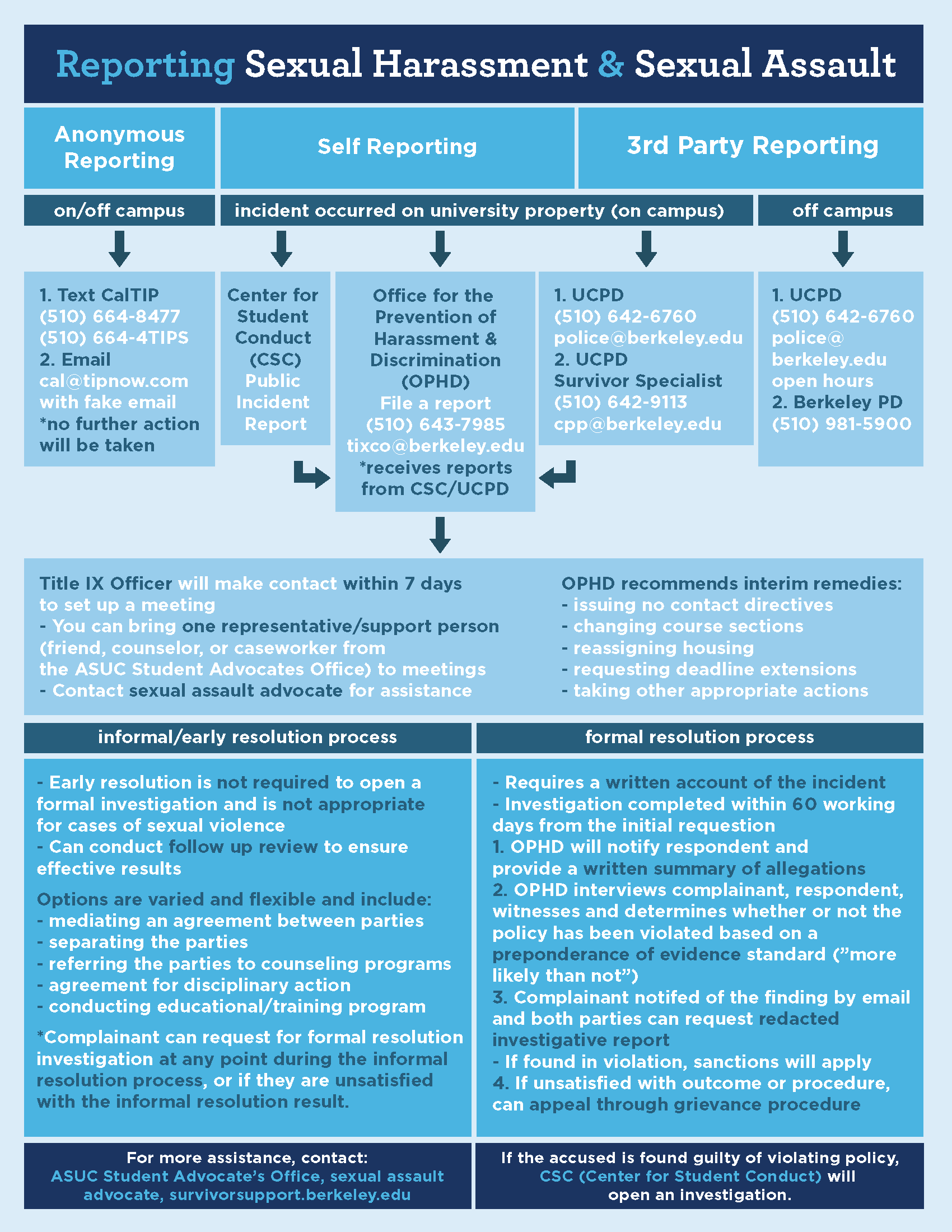
      We understand that the decision to report is difficult. However, if you wish to report an incident of sexual harassment or sexual assault, this post will explain how to report, the steps that may follow, and give some general tips. It will describe the different ways of reporting, including Anonymous, Third-Party, and Self Reporting. It will outline the processes of both Informal and Formal Investigations conducted by the Office for the Prevention of Harassment and Discrimination (OPHD).  Finally, at the bottom, you will find some Tips from SAO and Resources.

      Below is a caseworker-created infographic from the Grievance division. To see in detail, click the infographic and zoom in using your computer’s web browser.

      reportingsexualharassment

      Report Anonymously:

      • Understand that anonymous reporting means that you do not wish to disclose your name or any of the identities of the parties involved, and you do not want any action to be taken.
      • You can report anonymously using CalTIP (Berkeley’s text-based anonymous reporting tool to report non-emergency criminal activity) by texting (510) 664-8477 (4-TIPS), or by emailing cal@tipnow.com using a made up account.

      Report as a Third-Party/Self-Report:

      • Understand that once the University is aware of something threatening to the safety of the campus (such as a severe act of sexual harassment or sexual assault), the University has an obligation to investigate the incident whether you or the survivor is compliant or not.
      • There is no stated timeframe for reporting, but prompt reporting will better enable the University to provide an appropriate response. We encourage that all incidents be reported, even if a significant amount of time has passed.
      • You may report through the Center for Student Conduct by filing a Public Incident Report. Since the nature of the report concerns sexual harassment or sexual assault, this report will be forwarded to OPHD. The process for OPHD’s investigation will be outlined further below. This may be the best option if you want to initiate a Formal Investigation, which requires a written report.
      • You may also report through UCPD by calling their 24-hour non-emergency line at (510) 642-6760 (or 2-6760 from a campus landline), emailing police@berkeley.edu, or visiting the police department during open hours. Reporting to the police does not mean you are committed to filing charges.
      • If the incident occurred on University property, then UCPD will either conduct their own investigation, forward the case to OPHD, or do both, depending on the situation.
      • If the incident occurred locally, but off campus, UCPD will forward the case to Berkeley Police who will conduct the investigation. Alternatively, you can contact the Berkeley Police directly at (510) 981-5900police@cityofberkeley.info, or http://www.ci.berkeley.ca.us/police/.

      OPHD Investigation:

      • If you have chosen to report and OPHD has received your incident report, the Title IX Officer (Sexual Harassment Officer) will contact you, usually within 7 business days, to set up a meeting.
      • You should also receive a written explanation of your rights and options including: to whom to report, options for reporting to law enforcement, complainant rights such as no contact orders or restraining orders, importance of preserving evidence, existing campus services available, applicable procedures for disciplinary action, and options to change academic, living, transportation, and working situations.
      • Going into the meeting, be aware of your right to have one representative or designated support person accompany you. This may be a personal friend, a counselor, or a caseworker from our office who will advocate for you. You will have this right for all subsequent proceedings or meetings.
      • During the meeting you will have the option to pursue Early Resolution, Formal Investigation, or file a Formal Grievance. Details on filing a Formal Grievance can be found here. Information about the range of possible outcomes, including interim protections, remedies for the person harmed by the incident, and potential disciplinary actions will be provided for each option.

      Early Resolution (Informal Investigation):

      • Early Resolution is NOT required to open a Formal Investigation, and in some cases of sexual harassment or sexual violence, is not appropriate, and will be directly forwarded to a Formal Investigation.
      • The options for this have a wide range and are very flexible.
      • Results may include mediating an agreement between the parties, separating the parties, referring the parties to counseling programs, negotiating an agreement for disciplinary action, conducting targeted preventive educational and training programs, or providing remedies for the individual harmed by the offense.
      • It can also include options such as discussions with the parties, making recommendations for resolution, and conducting a follow-up review after a period of time to assure that the resolution has been implemented effectively.
      • This is recommended for anonymous reporting or third-party reporting.
      • The University cannot compel you to be involved in mediation. Mediation, even if voluntary, may not be used in cases involving sexual violence.
      • If Early Resolution is not appropriate, or is not successful, a Formal Investigation will be opened.

      Formal Investigation:

      •  Formal Investigation requires a written account of the incident. 
      • If the alleged conduct also contains criminal acts, both this Formal Investigation and a criminal investigation will run concurrently.
      • The investigation should be completed within 60 working days from the request of a formal investigation. The deadline may be extended on approval by the designated University official, but in such case, you will be notified of this extension.
      • The investigation will generally include interviews with the people involved. You may request to be notified of the date when interviews have begun. The people interviewed are told only what is necessary for a fair and thorough investigation, and that maintaining confidentiality is essential to the integrity of the investigation. As a witness, discussion of the investigation to the complainant or the accused is heavily discouraged.
      • At any time during the investigation, the investigator may recommend interim protections or remedies which must be abided, otherwise you will be in violation of the Policy.
      • You will be notified by the investigator when the fact-finding portion of the investigation is finished.
      • After evidence is collected, determination of violating Policy is based on a preponderance of evidence, meaning a more likely than not standard. Essentially, if the investigator feels like there is a 50% chance that the incident violating Policy had occurred, then the investigator will find the alleged in violation.
      • You will be notified of the final finding as to whether or not the Policy was violated. This will not include the written investigative report. However, you may request the redacted version of the report, which will at a minimum include a statement of the allegations and issues, the positions of the parties, a summary of the evidence, findings of fact, and a determination by the investigator whether this Policy has been violated.
      • If you are unsatisfied with the outcome or believe that the actions following the report of sexual harassment/sexual violence did not follow Policy, then you can file a Formal Grievance. For the former situation, the Early Resolution or Formal Investigation will act as the first step(s) of the Grievance procedure.

      Disciplinary Action:

      • If the alleged is found in violation of the Policy, then OPHD’s finding will be forwarded to the Center for Student Conduct (CSC). The finding may or may not include recommended disciplinary action; however, CSC will use the finding as evidence for their process.
      • Next, CSC will notify both you and the respondent when they start pursuing the case. This officially begins the conduct process.
      • An informal process will be pursued first. Someone from CSC will meet with the respondent to discuss possible sanctions, then you will be contacted for an informal meeting to discuss what you would like, and your preferences in regards to sanctions.
      • After these conversations, an Alleged Violation Letter (AVL) is sent to the respondent. The AVL contains the charge, a brief explanation of the facts that support the charge, and a recommended sanction.
      • Usually, for cases of sexual harassment, a sanction will be no less than  disciplinary probation for the remainder of the alleged’s time at the university. Other educational programs and/or reflection exercises might be additionally sanctioned.
      • The alleged will either accept the proposed sanctions, request a formal hearing, or not reply (in which case, sanctions outlined in the AVL are imposed). You will be contacted with either the result of the case or a notice that a formal hearing will be conducted.
      • If the alleged has accepted the proposed sanctions, but you are unsatisfied with the result, then you are allowed 10 days to submit a written appeal to the Deal. This is the last line of appeal. Understand that if you accept an informal resolution, you are waiving your rights to an administrative hearing and further appeal.
      • If the alleged opts for a formal hearing, then a Hearing Officer (HO) will try the case. Further information on the details and proceedings of the formal hearing can be found in the Code of Student Conduct on pages 13-17.
      • The HO’s decision will be emailed as a written report within 10 working days of the hearing to both parties. It will include a summary of the alleged perpetrator’s behavior, a determination of whether s/he was found responsible, and if found in violation, the sanctions to be imposed.
      • At this point, you may appeal to the Dean as the last line of appeal. You have 10 days to submit a written appeal.
    3. Enrollment and Dismissal Cases

      Dismissal and Academic Probation 
      If a student earns less than a 2.0 grade point average in any one semester, the University will notify the student of their changed status from Good Standing to Academic Probation. Terms of Academic Probation vary slightly between the Colleges. However, most commonly a student must earn higher than a 2.0 and earn zero F grades in the following semester to be removed from Academic Probation. If these terms are not met and the student earns less than a 2.0 and/or any F grades in the next semester, it is likely that they will be dismissed from the University.

      In order to appeal the dismissal, students must either successfully appeal individual grades that significantly affect their final standing, or negotiate their standing with the Academic Advisor or Student Affairs Officer.

      Dropping a class/changing a grading option after the Deadline 
      The drop deadline for most colleges is the Friday of the second week of the semester for impacted courses, and the Friday of the fifth week for all other courses. After this deadline you can no longer add or drop classes, nor change variable units in a class. The deadline to change your grading option is the Friday of the tenth week.

      It is possible to petition the University to retroactively change your status in a class after either deadline. However, these petitions are usually unsuccessful in cases that do not involve serious unexpected circumstances – such as a significant health problem. In addition, the petition process varies between the Colleges. If you would like to petition the University for a retroactive drop or change to your grading option, please stop by 204 Eshleman for further assistance.

      Tele-Bears
      Though Telebears may be considered a foolproof system to manage your class schedule, every so often a systemic glitch will lead to changes that you may not be aware of until it is too late.

      Check Telebears often and print a hard copy of your final schedule to prevent later problems. If you find that your schedule has been changed without your knowledge or approval, visit the Registrar’s office immediately.

    4. Withdrawing from the University: A Friendly Guide

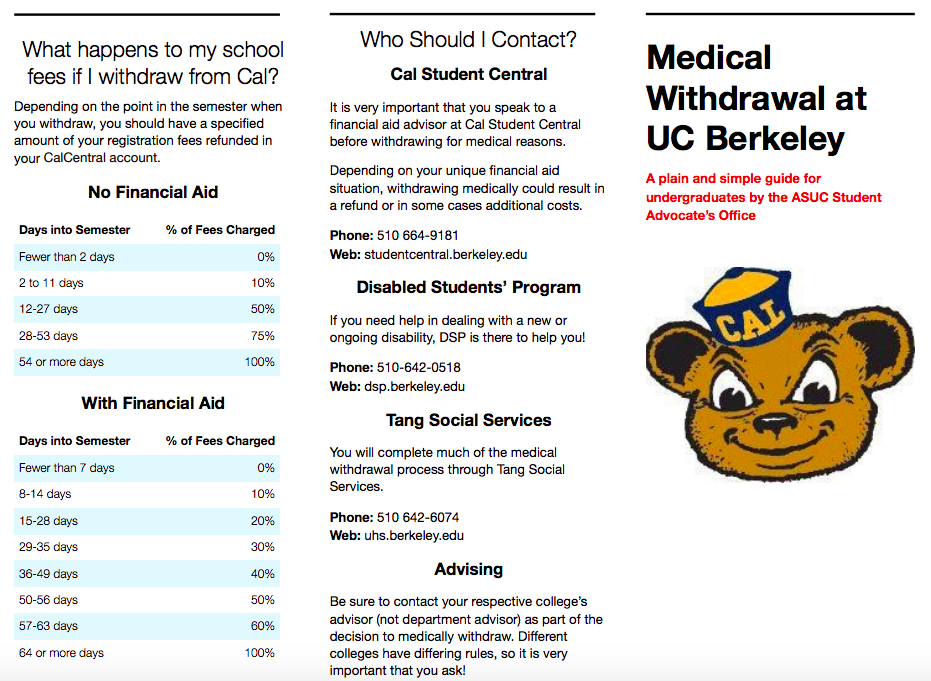
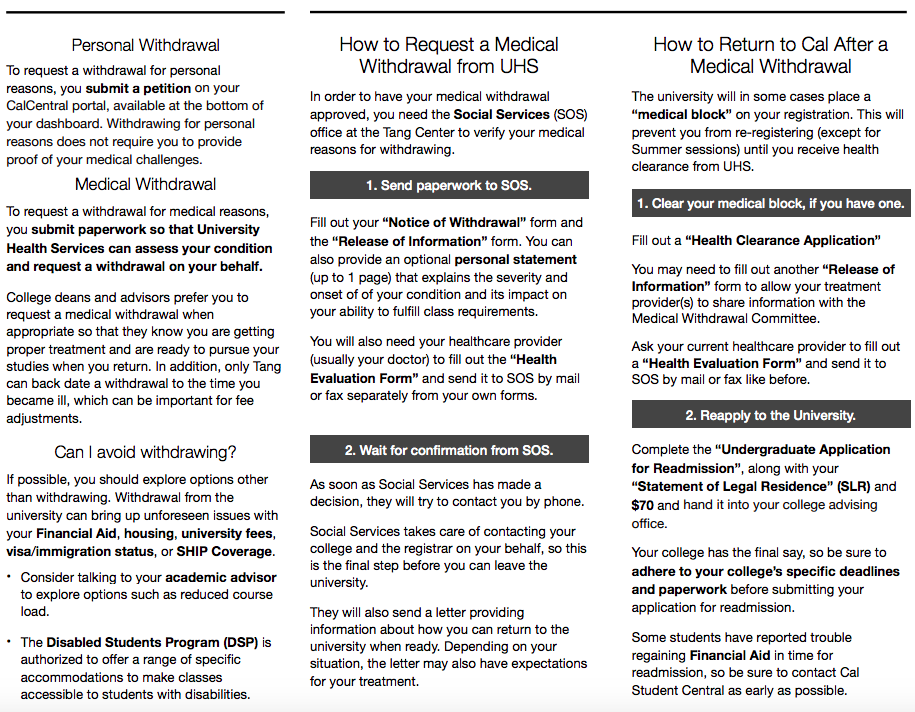
      Click the images below to see our printable pamphlet, or read on to see the text on this site.


      What are my options?

      Personal Withdrawal

      To request a withdrawal for personal reasons, you submit a petition to your specific college. Withdrawing for personal reasons does not require you to provide proof of your medical challenges.

      Medical Withdrawal

      To request a withdrawal for medical reasons, you submit paperwork so that University Health Services can assess your condition and request a withdrawal on your behalf. College deans and advisors prefer you to request a medical withdrawal when appropriate so that they know you are getting proper treatment and are ready to pursue your studies when you return. In addition, only Tang can back date a withdrawal to the time you became ill, which can be important for fee adjustments.

      See the bottom of this page at “HOW TO REQUEST A MEDICAL WITHDRAWAL FROM UHS” for a step-by-step process.


      Can I avoid withdrawing?

      If possible, you should explore options other than withdrawing. Withdrawal from the university can bring up unforeseen issues with your Financial Aid, housing, university fees, visa/immigration status, or SHIP Coverage.

      Consider talking to your academic advisor to explore options such as reduced course load. The Disabled Students Program (DSP) is authorized to offer a range of specific accommodations to make classes accessible to students with disabilities.


      Important Contacts

      Cal Student Central

      It is important to speak with a financial aid advisor at Cal Student Central before withdrawing from the university for medical reasons. Depending on your financial aid situation, medical withdrawal could result in a refund or in some cases additional costs.


      Disabled Students’ Program

      If you need help dealing with a new or ongoing disability, the Disabled Students’ Program (DSP) is there to help you!


      Tang Social Services

      You will complete much of the medical withdrawal process through Tang Social Services.


      Advising

      Be sure to contact your respective college’s advisor (not department advisor) as part of the decision to medically withdraw. Different colleges have different rules, so it is very important that you ask!


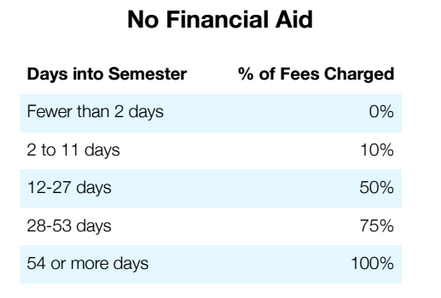
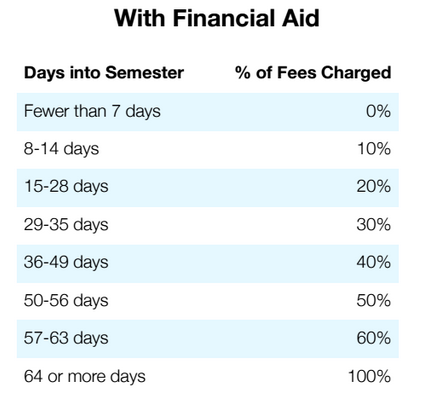
      What happens to my school fees if I withdraw from Cal?

      Depending on the point in the semester when you withdraw, you may have a specified amount of your registration fees refunded in your CARS account.

      Screen Shot 2015-04-20 at 8.47.20 PM

      Screen Shot 2015-04-20 at 8.49.35 PM


      Tables from: registrar.berkeley.edu/canwd.html

      If you are a financial aid recipient and withdraw, you may have to pay back all or part of your financial aid as you may no longer be eligible for the full amount of aid. You will be held responsible for all Housing and Dining charges prior to the first day of courses and after your effective date of withdrawal, if you are still in student housing.

      Fee adjustments, if any, are based on your withdrawal date. All fee adjustments for withdrawals are applied to your student account and may be applied to any outstanding debts. If you are participating in the Deferred Payment Plan and have not paid all your fees, you may still owe fees to the University. Please see tables below for prorated amounts.

      These fees are nonrefundable:

      • late fees
      • health insurance
      • class pass
      • document management

      How to Request a Medical Withdrawal from UHS

      In order to have your medical withdrawal approved, you need the Social Services (SOS) office at the Tang Center to verify your medical reasons for withdrawing.

      Medical withdrawals are considered for the current or previous semester. To be eligible for a medical withdrawal you must have registered and paid a percentage of your fees for the semester.

      1. Send paperwork to SOS.

      Information Required (See the Checklist for Medical Withdrawals)

      • Submit a Notice of Withdrawal form
      • Detailed medical record information (including diagnosis and treatment)
      • Your UHS medical record may be reviewed with a Release of Information Form
      • If you were treated in the community or at the UHS Counseling & Psychological Services, request that a Health Evaluation Form be completed by your provider. Your outside medical records can be reviewed with this Release of Information form.
      • You may also submit a brief explanation (up to one page) of the reasons you are requesting a medical withdrawal.

      Medical Withdrawal and Readmission Forms are also available in-person at the Social Services office.

      All information should be sent to Social Services, along with a copy of the Release of Information form you sign, so your provider can communicate with us.

      The above information is reviewed to determine if the medical condition warrants a medical withdrawal. The withdrawal determination is based on the severity and onset of your condition and its impact on your ability to attend classes over a period of time. The medical withdrawal documentation is also reviewed to determine what, if any, medical documentation will be necessary for health clearance when you seek to return to school. It is common for continued treatment over a period of time to be required as a condition of clearance.

      2. Wait for confirmation from SOS.

      As soon as Social Services has made a decision, they will try to contact you by phone. Social Services takes care of contacting your college and the registrar on your behalf, so this is the final step before you can leave the university.

      They will also send a letter providing information about how you can return to the university when ready. Depending on your situation, the letter may also have expectations for your treatment.


      How to Return to Cal After a Medical Withdrawal

      The university will in some cases place a “medical block” on your registration. This will prevent you from re-registering (except for Summer sessions) until you receive health clearance from UHS.

      1. Clear your medical block, if you have one.

      Fill out a “Health Clearance Application”. You may need to fill out another “Release of Information” form to allow your treatment provider(s) to share information with the Medical Withdrawal Committee. Ask your current healthcare provider to fill out a “Health Evaluation Form” and send it to SOS by mail or fax like before.

      2. Reapply to the University.

      Complete the “Undergraduate Application for Readmission”, along with your “Statement of Legal Residence” (SLR) and $70 and hand it into Cal Student Central in Sproul Hall.

      Your college has the final say, so be sure to adhere to your college’s specific deadlines and paperwork before submitting your application for readmission.

      In order to make sure you have timely Financial Aid support for your return semester,  be sure to contact Cal Student Central as early as possible in your readmission process.


      Helpful Links:

    5. Apply to the SAO

      Applications for Fall 2015 will be available at the beginning of the semester! Fill out our interest form here.

      (1) What is the Student Advocate’s Office?

      The Student Advocate’s Office (SAO) is an executive office of the ASUC. We offer advice and representation to any student or student group involved in a dispute with the University, effectively making us the campus public defender. We provide assistance for a broad variety of problems, including disciplinary allegations and violations, grade disputes, enrollment issues, financial aid problems, establishment of residency, discrimination, and harassment. All assistance is free and confidential.

      (2) What does a caseworker do?

      SAO caseworkers work with students on an individual, case-by-case basis, providing advice, support, and representation and helping students navigate the various administrative processes. Caseworkers also work with the University to improve policies and services.

      After selection, caseworkers are assigned to one of four divisions: Financial Aid & Residency, Academic, Conduct, or Grievance. Caseworkers are then provided with training and casework practice with senior staff members. As soon as they feel comfortable, new caseworkers may begin to handle cases on their own.

      Because our services are free to students, caseworker positions are unpaid.

      (3) Why should I join the SAO?

      SAO caseworkers gain invaluable experience applying their communication and critical analysis skills to real student cases, while helping students to resolve their conflicts with the University. In particular, caseworkers are able to develop strong relationships with various members of the University’s administration, while working in an office with some of the most interesting and talented students on campus.

      (4) What is the time commitment?

      All applicants must be free on Monday evenings at 7:30PM for our bimonthly office meetings.

      Each caseworker is required to fulfill 5 office hours per week. Because casework sometimes involves work outside of the office, working in the SAO generally requires about 5-8 hours per week. Additionally, all members of the SAO must participate in occasional events to publicize the office’s services.

      (5) How do I apply?

      Applicants should possess strong analytical skills, a high level of motivation, and excellent communication skills. Our most important concern is that applicants will be committed to the work that we do. We encourage all majors and ages to apply.

      The application for Fall 2015 is not yet available.

      If you have any questions, feel free to stop by our office, or email us at recruit@berkeleysao.org.

      We look forward to reading your application!


    6. How To: Complete A Formal Grievance

      If you have exhausted all attempts at an informal grievance and were unable to reach a resolution, you can file a formal grievance. This post will explain How To File, the Timeline for a formal grievance and (if necessary) an appeal, and the process of the Complaint Resolution Officer’s Investigation. At the bottom, you will find some Tips from SAO and Resources.

      How To File: 

      • The grievance form can be found here:  Student Grievance Procedure website
      • Your grievance must be written and signed by you or your designated representative*
      • Your grievance must contain:
        • your address
        • your phone number
        • detailed statement of the specific action being grieved,
        • the approximate date when the action took place,
        • the resulting injury or harm,
        • the specific law, policy, or rule alleged to have been violated (if known),
        • a description of the evidence supporting the grievance,
        • whether informal procedures were available and completed, and
        • the remedy or relief requested
      • *Representative/Advisor: If you will assisted by an advisor, you must submit his or her name and indicate whether he or she is a lawyer. You must also submit a signed statement authorizing your advisor to receive copies of relevant student records and correspondence regarding the grievance and to accompany you to any meetings.
        • Please note: The Student Advocate’s Office has many caseworkers available to represent you in informal and formal grievance procedures. Click HERE for more information.

      Timeline: You must file the formal grievance (see instructions above) within 60 days of…

        • the occurrence of the grievance
        • or of when you became aware of the grievance. (For example, if Joe is discriminated against on January 10 but does not become aware of this until January 17, he has 60 days from January 17 to file a formal grievance.)
        • Or, if you attempted to resolve the grievance through a department’s specific procedure, you have 10 days after the outcome of said procedure to file a formal grievance.
      • Within 20 days, a Complaint Resolution Officer (CRO) will review your grievance and respond as to whether it is completetimelywithin the Student Grievance Procedure’s jurisdiction, and constitutes a violation of a law or a University policy.
        • If the grievance is incomplete, you have 10 days (after the CRO’s response) to complete it.
        • Your grievance will be dismissed if 1) you fail to complete it within 10 days or 2) it is untimely, outside the Student Grievance Procedure’s Jurisdiction, or does not have sufficient factual evidence.
        • If your grievance raises multiple issues, the CRO will treat each one separately using the steps described above. As such, the CRO may investigate some issues and dismiss others.
      • If the CRO dismisses your grievance, he/she will provide you, in writing, an explanation for the dismissal. 
      • You have 10 days to appeal such a dismissal to the Vice Chancellor of Student Affairs or the Dean of the Graduate Division, as appropriate.
        • The Vice Chancellor or Dean will respond to you within 20 days. If your dismissal is upheld, the decision is final. If the dismissal is overturned, the grievance will be sent back to the CRO.
      • The CRO will complete an investigation and produce a report (see below) within 75 days of the initial receipt of your grievance. This report will be sent to the Vice Chancellor of Student Affairs or Dean of the Graduate Division, as appropriate, who will then determine the outcome and take necessary corrective action.
      • Written notice of the determination, including a description of the basis for the decision, will be sent to you and the respondent within 15 days.
      • If you would like to appeal the determination:
        • You have 10 days within receiving notice of the determination to do so.
        • You must submit a written request for reconsideration to the Vice Chancellor of Student Affairs or Dean of the Graduate Division, as appropriate.
        • Your request must meet at least one of the following grounds:
          • There is evidence that the Student Grievance Procedure was not followed, and this resulted in an outcome adverse to you, OR
          • There is evidence that the CRO made an obvious error in interpretation of evidence or law/University policy, and this error resulted in an outcome adverse to you.
        • The Vice Chancellor of Student Affairs of the Dean of the Graduate Division, as appropriate, will respond in writing within 30 days. This determination will be final.

      Complaint Resolution Officer’s Investigation:

      • The Complaint Resolution Officer (CRO) has 75 days to conduct, complete, and report the findings of an investigation of your grievance.
      • The CRO will send a copy of the written grievance and any supporting documentation to the head of the department or unit in which the violation allegedly occurred and ask for a written response.
      • The respondent will
        • confirm or deny each fact alleged in the grievance;
        • indicate the extent to which the grievance has merit;
        • indicate acceptance or rejection of any remedy requested by the grievant OR outline an alternative proposal for remedy
      • The grievant will receive a copy of the department’s or unit’s response.
      • The CRO may try to negotiate a resolution or administrative settlement of the grievance. If such a resolution satisfies both the grievant and the respondent, the CRO will notify both parties of the voluntary resolution in writing, and the grievance will be dismissed.

      Tips from SAO:

      • When submitting a grievance, try to focus on the facts and evidence, as well as the grievance’s impact on you. Avoid inflammatory or defamatory language. It is certainly understandable that the issue at hand is incredibly difficult for you, but please try to keep your formal grievance free of emotionally charged language.
      • Remember the procedure’s definition of Time: All time periods referred to in this procedure refer to calendar days, excluding summer term and inter-semester recesses. If the designated time period ends on a Saturday, Sunday or campus holiday, the time period will be extended to the following working day. The time periods designated in this procedure may be extended only where there is good cause and notice of the extension is provided to all parties.

      Resources:

      • The ASUC Student Advocate’s Office is a great starting point for someone wishing to file a grievance. We provide free, confidential support, advice, and representation. Our Grievance Division has many caseworkers available to help you through the grievance procedure, whether you pursue informal or formal resolution.
        • Contact: Visit us at 114B Hearst Gym between 10am-5pm, Monday through Friday. Email us at help@berkeleysao.org or give us a call at (510)-642-6912
      • The Office of the Ombudsperson for Students may be able to provide information and assistance with regard to informal resolution of student grievances.
        • Contact: (510)-642-5754.
      • The Office for the Prevention of Harassment and Discrimination may be able to provide information and assistance with regard to grievances alleging sexual and/or racial harassment; concerns of sexual or transgender orientation.
      • The ADA/504 Disability Complaint Resolution Officer may be able to provide information and assistance with regard to grievances alleging discrimination on the basis of disability or failure to provide reasonable accommodations to students with disabilities.
      • The Age Discrimination Act Coordinator may be able to provide information and assistance with grievances alleging discrimination on the basis of age.
        • Contact: Equity Standards & Compliance at (510)-642-2795.
      • The Office of the Vice Chancellor for Student Affairs may be able to provide information and assistance with regard to grievances alleging discrimination on the basis of veteran status, medical condition, ancestry, marital status, or citizenship.
      • The student may elect to bring complaints alleging violations of federal civil rights laws with the U.S. Department of Education, Office for Civil Rights. As provided in state law, civil law remedies, including injunctions, restraining or other court orders, and monetary damages also may be available to complainants.
    7. How To: Complete a Grade Appeal

      Formal Grade Appeal Process

      We are here to help! Contact us at academic@berkeleysao.org and we’ll assign you a caseworker who will guide you through the process, start to finish!

      How it Works

      The full process (on which this section is based) is listed here: http://guide.berkeley.edu/academic-policies/

      Part 1: Unit (Department) Level

      1. Each department or other instructional unit shall establish a standing grievance committee chair who is not the chair of the department.
      2. For each case, this chair will appoint an ad hoc grievance committee, consisting of:
        1. Three faculty members
        2. One faculty member from the same department/unit
        3. One faculty member from a different department/unit
        4. Two students in good standing appointed by the student association of the department.
      3. The ad hoc grievance committee will review all the required materials (from the student and instructor) and make a recommendation regarding a resolution.

      Part 2: COCI

      1. This recommendation is then sent to COCI (Committee on Course Instruction), including minority views, in writing.
      2. COCI has the power to change the grade, drop a course retroactively, or retain the course but eliminate the grade from the GPA.
        1. Note that changing the grade to a letter grade and not just a P requires that four out of the five ad hoc committee members need to recommend it.

      Timing

      1. The process must be started one calendar year from the last day of the semester in which the final grade for the course was posted.
      2. The formal procedure, once initiated, is to be completed at the unit level within 20-working days and at the Senate level within 40-working days if both parties are in residence and the University is in regular session.

      Student Instructions

      The full process (on which this section is based) is listed here: http://academic-senate.berkeley.edu/committees/coci/procedures-grade-appeals-based-alleged-use-non-academic-criteria

      (look especially at III.B for student instructions)

      Step 0: Informal Attempts

      If you have a grievance about a grade, you should first try to speak with your instructor and/or the student ombuds.

      Step 1: Assess the Strength of Your Case

      The following are grounds for appeal:

      1. the application of non-academic criteria, such as:
        1. the consideration of race, politics, religion, sex, or other criteria not directly reflective of performance related to course requirements;
      2. sexual harassment;
      3. or improper academic procedures that unfairly affect your grade.

      Step 2: Initiate the Formal Process

      Requirements are listed here: http://academic-senate.berkeley.edu/sites/default/files/committees/coci/gradegrievancechecklist_2011_v2.pdf

      Submit the case in writing to the department chair. Emailing is perfectly fine. This email should include your entire case:

      1. Specify clearly the grounds on which you are disputing the case, as listed here:
        1. Discrimination
        2. Sexual harassment
        3. Improper academic procedures that unfairly affect your grade
      2. There should be a “description of the basis for grievance”, and, if it exists, the original work in question.

      From here, the entire departmental process, including the ad hoc committee, must be completed within 20 days of the date of the email and sent to COCI.

      Step 3: Wait for, then respond to, the instructor’s rebuttal.

      1. The instructor will write and send a rebuttal through the ad hoc committee.
      2. Write a rebuttal to that rebuttal.
      3. The instructor will have one last chance to write another rebuttal before the case is judged and sent to COCI.

      Step 4: Option to submit additional written materials to the ad hoc committee

      1. The ad hoc grievance committee will meet to discuss all these materials. The student and instructor may present additional information in writing to the ad hoc grievance committee:
        1. prior to the meeting or,
        2. At the option of the ad hoc grievance committee chair, in person to the ad hoc grievance committee.
      2. Neither party may be present while the other is appearing before the committee or while the committee is deliberating.

      Step 5: Wait

      1. The department chair will forward all relevant documents and notify COCI in writing of the recommendation within two weeks of receiving the report from the ad hoc grievance committee.
      2. From here, all you can do is wait for the COCI judgement. This is required to take a maximum of 40 working days.